Flemish higher education
The Flemish higher education system is known worldwide for its excellent quality and high standards. Let's introduce it to you.
Flemish higher education system
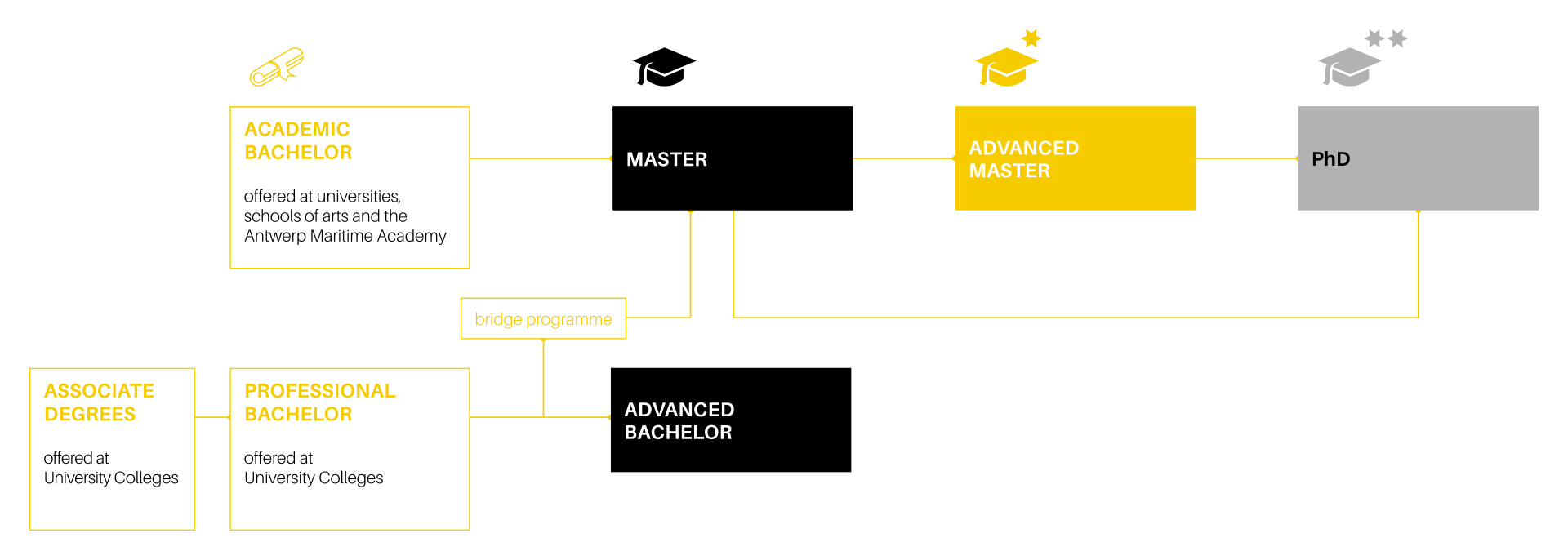
The Flemish higher education system is a binary system, consisting of 18 publicly funded higher education institutions: five universities, of which the oldest dates back to 1425, and 13 small and medium sized university colleges, also known as universities of applied sciences (and arts).
- Universities are research intensive universities, offering academic bachelor's degrees, master's degrees, advanced master's degrees, PhD’s and postgraduate certificates.
- Universities of applied sciences (and arts) are higher education institutions with a strong practice-based focus, offering associate degrees, professional bachelor's degrees, advanced bachelor's degrees and postgraduate certificates.
- The schools of arts are integrated in the universities of applied sciences and arts. Beside professional bachelor's degrees, schools of arts also offer academic bachelor's degrees, master's degrees, advanced master's degrees and PhDs.
- The Antwerp Maritime Academy offers professional as well as academic bachelor's degrees, master's degrees and PhDs.
All institutions offer higher education according to the principles of the European Higher Education Area. Their degree programmes are accredited (i.e. officially recognised) by the Accreditation Organisation of the Netherlands and Flanders (NVAO).
The language of instruction of most study programmes is Dutch. You will find English taught programmes at bachelor's level and more extensively at master's and PhD level. Overall you will find 12% of international students enrolled in Flemish higher education institutions.
The Flemish Higher Education system is part of the European Higher Education Area, where we use the ECTS credit system. ECTS stands for European Credit Transfer System. A year of full-time studies at university or university of applied sciences level is generally worth 60 ECTS credits, and defined as equal to 1,500 - 1,800 hours of study work. This means 1 ECTS is equal to between 25 to 30 hours.
Degree programmes
- An associate degree (90-120 ECTS) is a practice-based programme between secondary education and a professional bachelor's degree (European Qualification Framework level 5). Workplace learning accounts for at least a third of the study load and it prepares you in two years for the labour market or for a professional bachelor's programme. Flemish universities of applied sciences (and arts) offer associate degrees only in Dutch.
- A professional bachelor's degree (180 ECTS) is a bachelor's degree combining general knowledge with practical competences, including compulsory internships. It prepares you for the labour market in three years. Exception: a bachelor's degree in nursing takes four years (240 ECTS). If you want to proceed studying for a master's degree at a Flemish university, a bridging programme will be required.
- An academic bachelor's degree (180 ECTS) is a bachelor's degree offered at a university, a school of arts or the Antwerp Maritime Academy. It has a strong theoretical focus and prepares you for master's studies.
- An advanced bachelor's degree (60 ECTS) is a bachelor's degree offered at a university of applied sciences. It provides you with wider and more specialised knowledge and competences in your field of study.
- A master's degree (60-120 ECTS) has a strong focus on advanced scientific or artistic knowledge and research competences. Most English taught programmes in Flemish higher education are at master's level.
- An advanced master's degree (60-120 ECTS) offers specialised training, often linked to top research areas of the home university and is aimed at students who already earned an initial master's degree.
- A PhD is a doctoral degree, awarded to students who complete a research thesis offering a new contribution to knowledge in their subject. Each Flemish university has several doctoral schools offering PhD programmes preparing PhD graduates for a career in both academia and beyond. For PhD programmes please contact the university of your choice directly (see links below).
Other programmes
- A postgraduate certificate (min. 20 ECTS) offers specialised training in a very specific area. It does not result in a diploma.
- Summer courses are short courses of one or two weeks organised during the summer holiday. Many of these courses allow you to earn credits (eg. 3 ECTS for two weeks) and are a great opportunity to get a glimpse of Flanders and Brussels as a study destination.
- Exchange programmes are programmes you can attend when you come on credit mobility to Flanders or Brussels, while you stay enrolled in your home institution. All 18 Flemish Higher Education Institutions have a wide range of partner institutions around the world. For an overview of these exchange programmes click here.

Academic calendar
The academic year starts in September: mid-September at the universities of applied sciences (and arts) and one week later at the universities. The majority of study programmes are divided into two semesters. At the end of each semester you have a final exam series of the courses of that semester (January and June). If you fail a course, you have the opportunity to do retakes during the third examination period in August and September.
Students have a mid-year break in February and a two-week break at Easter. In summer, most campuses are closed from mid-July until mid-August.
Good to know: a very limited number of study programmes allows students to start in February. Please check if this is the case for the programme of your choice.
5 universities

13 universities of applied sciences (and arts)